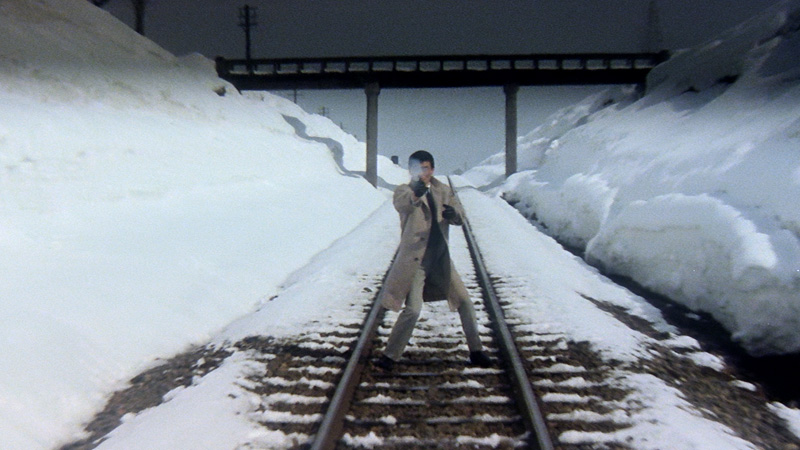
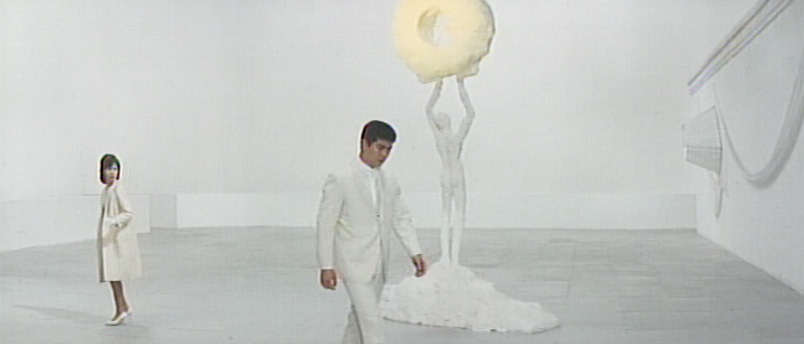
As visually chaotic as Tokyo Drifter appears to be, on a purely abstract level, the color design in this film can operate entirely as its own (separate from the scripted narrative)
and tell the same story without effort. What is unsaid or uncertain by
scripted means is made clear and reinforced through the use of
color.
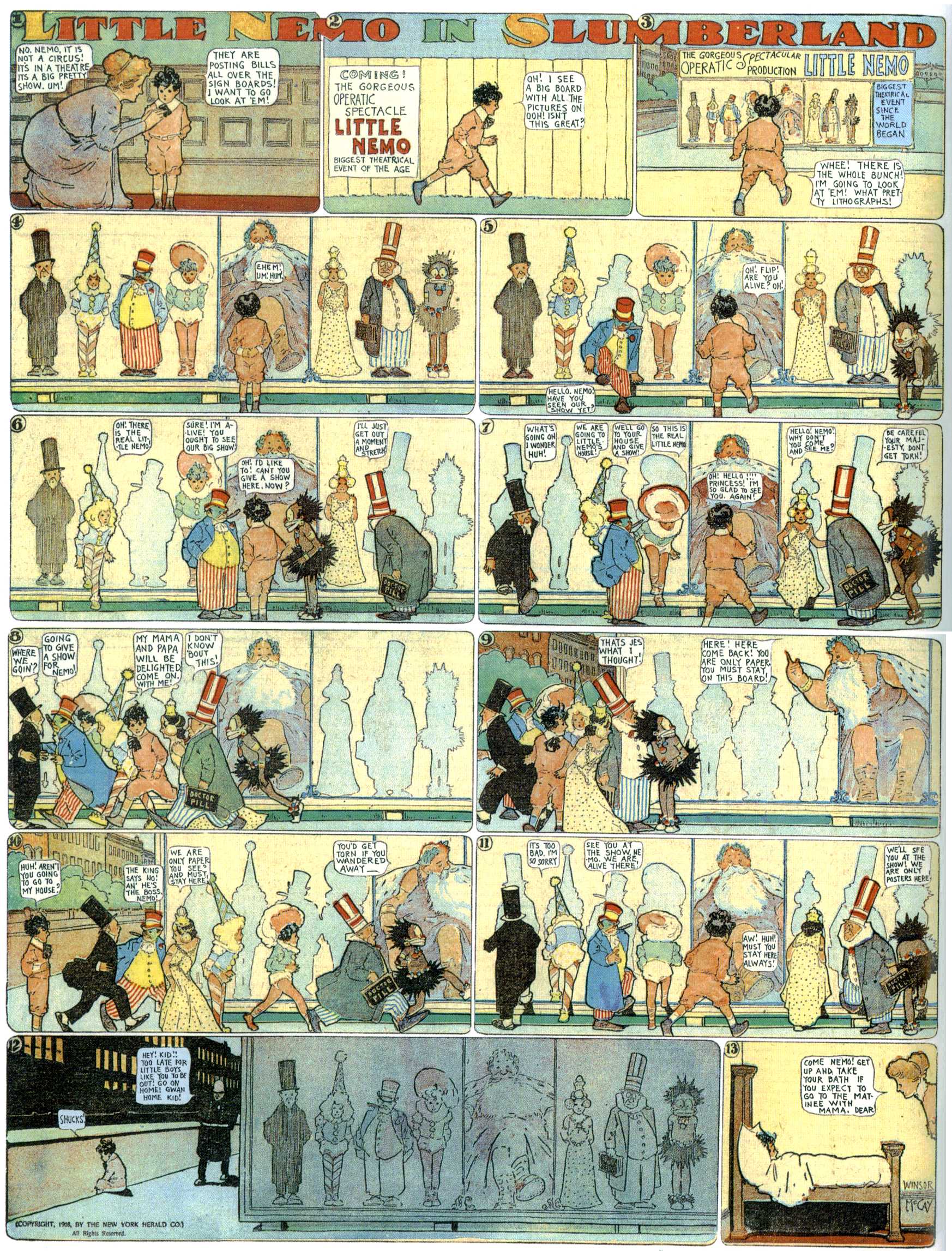
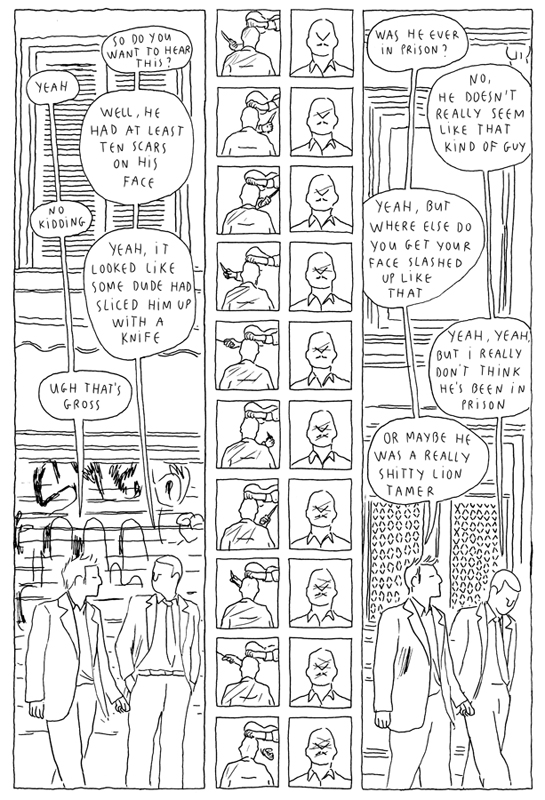
Amazing work by the french duo Florent Ruppert and Jérôme Mulot. Their comics emphasize sequential movements between panels which lends itself nicely when transitioning into animation. Reminds me a little of Winsor McCay.
I'm quite partial to jarring cuts in between sequences of film
(regardless of how obsessive they seem or how much they challenge
continuity) because they are bizarrely contradictory: the successions of
cuts are quick and yet they seem to slow down the moments they
interrupt as if the brain is taking extra time to sort out the
condensely packed images (I suppose this is actually the case).
Here are some examples of interesting "quick cuts" I've come across recently.
Mean Streets (1973)
The entire title sequence is incredible---from the cut to a projector that comes out of nowhere, to the home movie, to the music---but the cutting that takes place in between the shots of Charlie's head hitting the pillow is what I want to talk about. As the character falls back in slow-motion, the camera cuts closer and closer to his face. Yes, the editing matches the beat of the music, but abrupt cutting of a single action paired with the slow-motion is fascinating. It is at once both jarring and dream-like, informing us that we are about the enter Charlie's psyche, one of heavy conflict, contradictions, and sensual rawness.
Stolen Kisses (1968)
(Note: Obviously, we'd get a better sense of the rhythm editing with a video, but I couldn't find a clip of this scene anywhere.)
Working as a detective, Antoine Doinel loses sight of the magician he's suppose to be tailing when he decides make a phone call to his girlfriend. Realizing this, he exits the phone booth in a hurry. In what could have been filmed within one shot, what we get instead is an odd series of shots from two different perspectives of him leaving: One from an interior shot in the booth and one exterior. The sort of "rack" cutting of between the two shots happen rapidly, lasting less than a second. It's almost like a subliminal message or even a glitch, as if someone accidentally included a couple frames from the next shot when cutting the scene together. This disruption in the follow of Antoine's exit heightens the anxiety of the situation (though rather quickly) with the flash of the interior shot attempting the keep Antoine within the booth when he clearly needs to leave.
Let me stress the fact that the cuts are telling us this information, not necessarily what is happening within the shot.
The Color Wheel (2011)
This example is a little different of the first two. It's more about condensing time and space than adding extra information to the scene.
At first glance, the cutting of this transition moment between locations seems somewhat strange. As the brother and sister duo, Colin and JR, make their way from a motel to the diner, we first see a shot of a car driving on the road, then a cut to the car pulling up to the diner, and a final cut of the car already parked with Colin and JR walking into the restaurant. We have witnessed a jump-cut people! What make this interesting is that the attempt to condense time is somewhat negated by the car moving in the first two shots and then is stationary in the last one.
According to Guy Dubord, the spectacle is the most glaring superficial manifestation of mass media. Idealized lives, carefully constructed narratives of film, television, and literature, the presentation and function of our commodities, these are all subject to the influence of the spectacle. It’s a critique of contemporary consumer culture. We are so mesmerized by the spectacle of our society that ordinary objects, locations, images have become emotionally charged. They have become our link to the people around us. We live for objects and images because we do not know of any other way to live.
How can small stories and the mirco-narratives of ordinary life compete with the spectacle? Is it not inherently influenced by mass culture? The discovering the spaces in between reality and fiction are the only ways we can find grace from the influence of the spectacle. The fleeting moments, the trivial events, inspired instances of play are occurrences that can foster new ways of seeing only if one takes the time to examine them. I like to think of them as spectacles of the ordinary. Capturing and interpreting this idea through visual media, how can the nature of the ordinary change our idea of visual representation? Can the ordinary exist as spectacle or does is very qualities negate its transformation?
There he goes. Eating a hamburger. He doesn't even finish it.
And why should we care about this?
Is this a joke? Were we tricked? Did we wasted our time watching this?
In Warhol’s Eating a Hamburger (1982), we are
presented with a incredibly mundane situation. It just Andy. He's
just eating a hamburger. Yet the very medium of video makes it an event. There is
action, drama, and mystery (why didn't he finish that hamburger???)
It is at once mesmerizing and distancing. A screen that demands our gaze and yet offers us something that can be found in the everyday.
We can read into whatever we like about this piece. I like to think of it as a spectacle.
The important things don’t matter as much as the details. I understand the gist of an overall grand scheme of a narrative or whatever but those ideas doesn’t really interest me. They are sort of finite. I like things to have a little wiggle room for interpretation purposes. That’s why I tend to fixate on the little things; the details that are small and brief, but if you stare at it long enough, it tells to everything and more.
I was listening to Filmspotting the other day---its a great movie podcast by the way---and I happened to catch a tidbit about this strange connection between a scene from David Lynch's Mulholland Dr. (2001) and the ending of Singin' in the Rain (1952):
Watching these two clips back to back, there a feeling of this hidden narrative that haunts both films (Perhaps more for Singin' in the Rain than for Mulholland Dr.) It is our human nature to find a connections to and make sense of what we are seeing. When viewing them in this order, I don't attribute Lina Lamont's expression of anxiety to the curtain being lifted from the stage and being exposed, but to what happened to the singer in Mulholland Dr. Whether or not it was Lynch's intention to directly reference Singin' in the Rain (does anyone know?), this comparison definitely speaks to the power of the film archive as a ever changing meta-narrative.
The view of the set is made visible. We are watching a movie.
Have a gander everybody:
Here, Aitor Gametxo reorganizes the film "The Sunbeam" from 1912 by D. W. Griffith into the prefect six-rectangle grid “doll-house” where the movements of the characters are perfectly choreographed to interact with the hidden structure.
In this Rear Window timelapse, Jeff Desom dissects the scenes from Hitchcock's film and---since everything was filmed from pretty much the same angle---he was able to match them into a single panoramic view of the entire backyard with the order of events staying true to the movie's plot.
Especialy in early cinema, the camera rarely moves from the position of 180 degrees from the subject and is typically inter-cut with the occasional medium shots and closeups. Because of editing, the spatial structure of a film is often not noticeable when it constantly cuts back and forth between shots. These are fascinating examples that breakdown and reveal the surprisingly simple way of how well known filmmakers compose various shots to explore location within the narrative.
And by "here," I meant the Shire.
It is a reminder of human mortality. Things never remain in a fixed state. A fruitless attempt to leave evidence, yada yada yada . . .